The driver qualification file is the most common reason a small carrier fails a new-entrant audit. Not because the rules are mysterious — they're spelled out in 49 CFR §391.51 — but because a single missing item makes the whole file out of compliance. This guide walks every item. (If you are hiring a driver and need the order things must happen in before day one, start with the first-hire sequence and come back here for the file itself.)
What a DQF is, and what it isn't
A driver qualification file is the FMCSA-mandated dossier of documents that prove a driver is legally and physically qualified to operate a commercial motor vehicle. It is not an HR file. It is not a personnel folder. It does not include payroll, performance reviews, or disciplinary write-ups. It also does not include drug and alcohol testing records — those live in their own confidential file (more on that below). The DQF is its own thing, governed by 49 CFR §391, and it has a specific composition and specific retention rules.
Every driver — including the owner-operator who is also the only driver — needs a DQF. The §391 requirements have very narrow exemptions and "I'm the owner" is not one of them.
What goes in a complete DQF
Below is every document an auditor expects to see for driver qualification. Most trace directly to §391.51(b); a few come from related rules elsewhere in Part 391, cited per item.
1. Driver's application for employment
Required by §391.21. Must contain the items listed in §391.21(b): name, address, date of birth, and Social Security number; residences for the past three years; every unexpired CMV license or permit with its issuing authority, number, and expiration; driving experience by equipment type; all motor vehicle accidents in the past three years; all traffic convictions (other than parking) in the past three years; any license denial, revocation, or suspension; employers for the past three years with dates and reasons for leaving — and, for drivers who need a CDL, the CMV-driving employers for the seven years before that; and the signed certification that the entries are true.
For a single-driver owner-operator, you complete this form on yourself. Yes, even if you're the company. The form date should be the date you began operating under your USDOT number.
Retention: Duration of employment + 3 years.
2. Inquiry to previous employers
Required by §391.23(a)(2). For each commercial motor vehicle employer in the past three years, you (or someone on your behalf) must contact them and request specific information: dates of employment, accidents, and any drug & alcohol testing program participation.
Note that the safety performance history you collect under §391.23(d)/(e) — including the drug & alcohol portion — is maintained in a separate investigation-history file under §391.53, not commingled into the DQF. You still need to document each contact attempt.
Retention: Duration of employment + 3 years.
3. Inquiry to state agencies (MVR check)
Required by §391.23(a)(1). You must obtain a motor vehicle record (MVR) from every state where the driver held a CDL or had a driver's license in the past three years. For most owner-operators that's one or two states.
Retention: Duration of employment + 3 years for the initial inquiry; subsequent annual MVRs follow item 4 below.
4. Annual driving-record inquiry response
Required by §391.25(a). At least once every 12 months you must obtain a new MVR for each driver. Same MVR pull as the initial inquiry, just done annually.
Retention: 3 years per inquiry.
5. Note of annual review of driving record
Required by §391.25(b). After receiving the annual MVR, the carrier must conduct a written review of the record and document that the review took place — including any disqualifying offenses, any pattern of unsafe driving, and the carrier's determination of continued qualification.
This is the item carriers most often skip. The MVR alone is not enough. You also need the review document.
Retention: 3 years per review.
6. Road test certificate
Required by §391.31. The driver must pass a road test administered by a qualified person, or the carrier may accept a CDL in lieu of a road test under §391.33(a)(1).
If you accept a CDL in lieu of a road test, §391.33(b) requires a legible copy of the CDL in the file — note that the CDL counts only for the vehicle types it licenses, and doubles/triples and tank endorsements never substitute for a road test on that equipment (§391.33(a)(1)).
Retention: Duration of employment + 3 years.
7. Medical examiner's certificate
Required by §391.41 through §391.43. The driver must hold a current medical examiner's certificate issued by a certified medical examiner on the FMCSA National Registry. For CDL and CLP holders, the medical examiner transmits the certification to the State, and the DQF record is the CDLIS motor vehicle record showing that status (§391.51(b)(6)(ii)) — not a copy of the card. For drivers who do not need a CDL, the certificate (or a legible copy) goes in the file (§391.51(b)(6)(i)).
Retention: 3 years from date of examination, OR the certificate must be current — whichever ends later.
8. Skill performance evaluation certificate (if applicable)
Required by §391.49. Only applies to drivers operating under a Skill Performance Evaluation Certificate for a physical impairment.
Retention: 3 years from execution (§391.51(d)(4)).
9. Medical variance documentation (if applicable)
Required for drivers operating under a vision or diabetes exemption. Same retention as item 8.
10. NRCME verification note (non-CDL drivers)
Required by §391.51(b)(8)(i) and §391.23(m)(1): a note verifying that the medical examiner who performed the exam was listed on the National Registry of Certified Medical Examiners on the date the certificate was issued. Non-CDL drivers have needed this note since May 21, 2014. For CDL drivers, the parallel note was required only through June 22, 2025 — medical certification status now rides on the CDLIS motor vehicle record instead (see item 7).
Retention: 3 years from execution.
11. Disqualification documentation (if applicable)
If a driver is disqualified under §391.15 for any reason, the carrier maintains documentation of the disqualification, the basis, and any corrective action. This isn't an enumerated §391.51(b) item, but an auditor will expect it on file whenever a disqualification has occurred.
Retention: Duration of employment + 3 years.
Where drug & alcohol records actually go
This trips up a lot of small carriers, so it gets its own section: drug and alcohol testing records are not part of the DQF. Pre-employment test results, random and post-accident results, refusals, return-to-duty documentation, and your Clearinghouse query results all belong in a separate, confidential file with restricted access under 49 CFR Part 382. Mixing confidential test results into the DQF isn't just untidy — it's a finding an auditor can cite, and it exposes protected information.
Two practical notes for a one-driver operation: you still must have a verified negative pre-employment drug test on file before performing any safety-sensitive function (§382.301), and you must run a pre-employment Clearinghouse query and at least one annual query thereafter (§382.701). Those records simply live in your D&A file, not your DQF. Query records were never a DQF item, and as of January 6, 2023 a carrier with a valid Clearinghouse registration satisfies the §382.701(e) query-record requirement through the Clearinghouse itself.
Common DQF mistakes
- Including the rescinded annual violation list. §391.27 — the driver-furnished annual list of violations — was rescinded on May 9, 2022. The annual MVR and review (items 4 and 5) cover the same ground. Plenty of DQF templates in circulation still include it; if yours does, the template is out of date. It's clutter, not compliance.
- Missing the annual review note (item 5). Carriers pull the MVR, file it, and forget the written review. The MVR alone doesn't satisfy §391.25(b).
- Stale MVRs. The annual MVR must be no older than 12 months. A 13-month-old MVR is non-compliant.
- Expired medical certificates. A driver operating with an expired medical certificate is operating illegally. Track every cert's expiration date.
- Missing CDL on file. If you accept the CDL in lieu of road test, you need a current copy of the CDL.
- No previous-employer inquiry documentation. You sent the requests; did you keep proof? Email confirmations, fax receipts, and certified mail receipts all count. "I called them" doesn't.
- Commingling drug & alcohol records into the DQF. Keep them separate and confidential, as above.
- Single-driver owner-operator with no DQF on themselves. This is the most common new-entrant failure. The owner-operator IS a driver under §390.5T. The DQF rules apply.
What to keep, and where
The DQF itself is one file per driver. Organize the items in §391.51 order so an auditor can scan it in two minutes. Documents go in as PDFs (or originals if paper); emails go in as printed PDFs with headers visible, and every retention period is tracked.
Two sets of records stay out of the DQF, in files of their own: your drug & alcohol testing records (a separate, confidential, access-restricted file under Part 382) and your safety performance history / previous-employer investigation records under §391.53. Keeping them separate isn't optional housekeeping — it's how the rules are written.
Roadworthy HQ enforces the §391.51 list automatically: every driver has a DQF view that shows present items, missing items, and items approaching their renewal date — and it keeps drug & alcohol records on their own tab, apart from the qualification file. Retention is enforced by the database: documents purge automatically when the CFR retention period ends, with a 7-day grace window and legal-hold support. The product tour shows the driver file view — and the rest of the workspace — on real demo-fleet data.
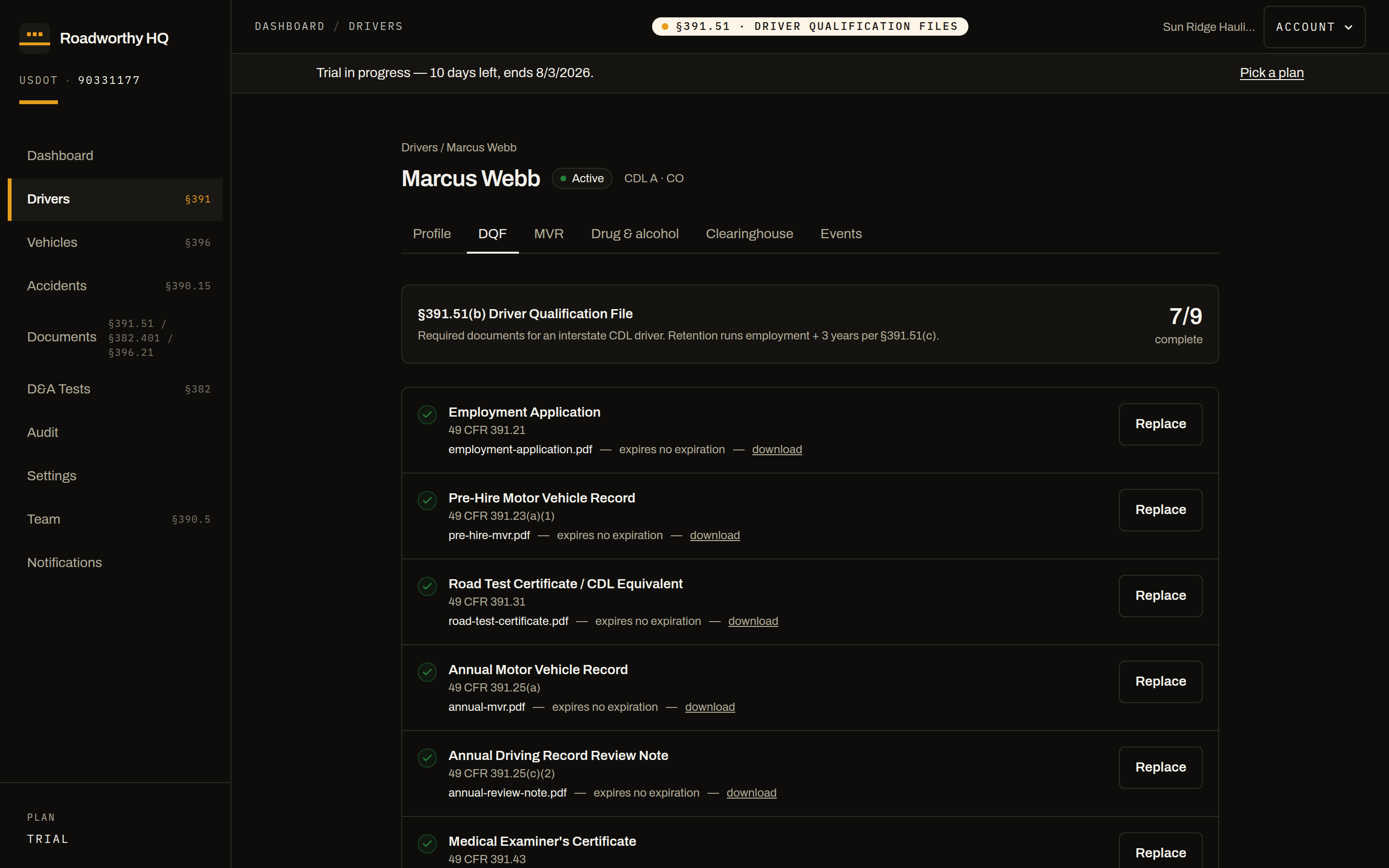
If you'd rather build it yourself in a spreadsheet and folders, the structure above is the one auditors recognize. And if you're weighing software options for the job, the J.J. Keller alternatives comparison walks through what each shape of tool — platform, service, or DIY — actually costs and covers.
Try the DQF Completeness Checker
Before your audit letter arrives, run your file through the DQF Completeness Checker. It takes about 10 minutes, walks every §391.51(b) item, and outputs a gap report you can save or print.
This article is general guidance, not legal advice. For your specific situation, consult counsel or a qualified compliance professional.
Related violation codes
The requirements covered above are cited as these violation codes in audits and roadside inspections:
- §391.51 — Driver qualification file incomplete
- §391.21 — No or incomplete application for employment
- §391.23 — Previous-employer investigation not made
- §391.25 — Annual driving record inquiry and review
- §391.31 — Road test required
- §391.41(a) — Driver lacking valid medical certificate
- §391.15 — Allowing a disqualified driver to operate a CMV
- §382.301 — No pre-employment drug test
- §382.701 — Missing Clearinghouse pre-employment or annual query