You got a roadside inspection, or a broker asked about your "CSA score," or you read that a bad score can cost you loads — and now you're trying to figure out what the number even is. Here's the part nobody tells you up front: if you run one or two trucks, you probably don't have a public CSA score at all, and that's normal. The system was built to rank fleets against each other, and a carrier with a handful of inspections usually doesn't have enough data to be ranked.
This is the plain-English version — what the score is, how FMCSA builds it, why yours may be blank, and the short list of things that actually change it.
CSA, SMS, and BASICs — three names for one system
CSA (Compliance, Safety, Accountability) is the FMCSA enforcement program. Inside it is the SMS (Safety Measurement System), the algorithm that turns your roadside inspections and crashes into numbers. Those numbers are grouped into seven BASICs — Behavior Analysis and Safety Improvement Categories. When someone says "your CSA score," they almost always mean your SMS percentile in one or more BASICs.
A CSA/SMS percentile is not a safety rating. A safety rating — Satisfactory, Conditional, or Unsatisfactory — comes out of a formal compliance review under 49 CFR Part 385 and is a separate process. Your SMS percentiles are a prioritization tool: they help FMCSA decide who to look at next. Don't confuse the two. (We cover the audit side of this in the new-entrant safety audit timeline — the audit is pass/fail and assigns no rating either.)
The seven BASICs — and which ones the public can see
FMCSA sorts every violation into one of seven categories. Only five are shown publicly; two are hidden from public view under the FAST Act of 2015 and are visible only to you (when you log in) and to enforcement.
| BASIC | What it covers | Public? |
|---|---|---|
| Unsafe Driving | Speeding, reckless driving, texting, seat belt, lane use | Public |
| Hours-of-Service Compliance | Log/ELD violations, driving over hours, false records | Public |
| Driver Fitness | Missing/invalid medical cert, CDL, qualification file | Public |
| Vehicle Maintenance | Brakes, tires, lights, defects, DVIRs | Public |
| Controlled Substances/Alcohol | Drug and alcohol violations found at roadside | Public |
| Crash Indicator | Frequency and severity of DOT-recordable crashes | Not public |
| Hazardous Materials Compliance | HM placarding, packaging, paperwork | Not public |
A broker or shipper checking you out sees the five public BASICs on the SMS website. They cannot see your Crash Indicator or HM Compliance percentile — but FMCSA can, and uses them.
How the number is built
For each BASIC, FMCSA runs the same three-step math on your last 24 months of inspection and crash data.
Step 1 — weight every violation for severity. Each violation carries a severity weight from 1 to 10. A burned-out lamp is a 1 or 2; driving over your hours or a serious brake defect is much higher. The controlled-substances and unsafe-driving violations tend to carry the heaviest weights because they map most directly to crash risk.
Step 2 — weight every violation for recency. This is the part small carriers underestimate. A violation is multiplied by a time weight based on how old it is:
- Within the last 6 months → counts 3×
- 6 to 12 months old → counts 2×
- 12 to 24 months old → counts 1×
- Older than 24 months → drops off entirely
So a violation you picked up last month hits three times harder than the same violation from a year and a half ago. It also means a clean stretch heals you: keep your nose clean and old violations age out on their own.
Step 3 — normalize and rank. FMCSA adds up your severity × time weighted violations, divides by your exposure (your number of relevant inspections, and for some BASICs your power units and mileage from your MCS-150), and produces a measure. It then drops you into a peer group of carriers with a similar number of safety events and ranks everyone. Your rank becomes a percentile from 0 to 100, where higher is worse. A 90 in Unsafe Driving means you look worse than 90% of your peers; a 20 means better than most.
This is why accurate mileage on your MCS-150 matters: under-report your miles and your exposure looks smaller, which can push your percentile the wrong way.
The intervention thresholds — when FMCSA starts paying attention
A high percentile only matters once it crosses a line. For general-freight (property) carriers, the intervention thresholds are:
- 65% for the three BASICs most tied to crash risk: Unsafe Driving, Hours-of-Service Compliance, and Crash Indicator.
- 80% for Vehicle Maintenance, Controlled Substances/Alcohol, Driver Fitness, and HM Compliance.
(Passenger and hazmat carriers cross at lower, stricter numbers — 50% and 60% for the first group. Those aren't you if you haul general freight.)
Cross a threshold and you move up FMCSA's priority list. The interventions escalate roughly like this:
- Warning letter — an early notice that a BASIC is over threshold.
- Targeted roadside inspections — enforcement is flagged to inspect you more often. One over-threshold BASIC makes the next inspection more likely, and more inspections mean more chances to add violations. It compounds.
- Off-site or on-site investigation — the deeper look that can end in a compliance review and a safety rating.
An acute or critical violation found during an investigation (for example, no drug-and-alcohol testing program, or using a driver with no valid medical certificate) can trigger enforcement on its own, regardless of your percentiles.
Why your score is probably blank — and why that's fine
Here's the reframe for a one- or two-truck operation. Before FMCSA assigns you a percentile in a BASIC, you have to clear a data sufficiency bar — enough inspections (with violations) for the ranking to mean anything:
- Unsafe Driving and HOS Compliance: a minimum of 3 inspections with a violation in that BASIC.
- Driver Fitness, Vehicle Maintenance, Controlled Substances/Alcohol, HM Compliance: a minimum of 5 inspections with a violation.
- Crash Indicator: a minimum of 2 crashes in the 24-month window.
Fall short and the BASIC reads "Insufficient Data" — no percentile, nothing public. A brand-new carrier with two clean inspections and no crashes will show no scores in most or all BASICs. That is not a problem to fix. It means the system doesn't have enough on you to rank you, which is exactly where a careful small carrier wants to be.
What it does not mean is that you're invisible. Every inspection and violation is still recorded against your USDOT number and still counts toward the data-sufficiency bar. One bad month of roadside violations can move you from "Insufficient Data" to over-threshold faster than you'd expect, precisely because you have so few inspections to dilute them.
What actually moves your score
For a small carrier, the levers are short and boring — which is good news, because boring is controllable.
Avoid the high-severity, high-frequency violations. A single speeding citation feeds Unsafe Driving; brakes out of adjustment feed Vehicle Maintenance; a record-of-duty-status that isn't current feeds Hours-of-Service. These are the violations inspectors write most often on small carriers. A solid pre-trip, a driver who logs honestly, and a maintenance file you actually keep prevent most of them. (Our guides on the vehicle maintenance file and ELD and HOS records cover the recordkeeping side.)
Keep collecting clean inspections. Because everything is normalized by exposure and time-weighted, clean inspections dilute old violations and recent violations age out. You can't delete a real violation, but you can out-run it with a clean record.
Challenge violations that are actually wrong — through DataQs. If a roadside report lists a violation that isn't yours (wrong USDOT number, a defect that was already repaired, a citation later dismissed in court), you can file a Request for Data Review through FMCSA's DataQs system. Attach the proof — the repair receipt, the dismissed ticket, the corrected report. A successful challenge removes the violation from your SMS calculation. Don't dispute violations that are legitimate; do dispute the ones you can document as errors.
Use the Crash Preventability Determination Program for eligible crashes. For certain crash types (you were struck in the rear, struck while legally parked, struck by a wrong-way or impaired driver, and others), FMCSA's Crash Preventability Determination Program will review the crash. If it's found not preventable, it's marked as such and no longer counts against your Crash Indicator. You have to submit the police report and supporting evidence — the crash isn't reviewed automatically.
The change on the horizon: Enhanced SMS
FMCSA has approved a rebuilt version of the SMS, usually called Enhanced SMS, published in the Federal Register on November 20, 2024. As of July 2026 it is not in effect — everything above is still the system that governs you today. Enhanced SMS is currently in a preview phase: you can log into the Prioritization Preview tool to see how your numbers would change under the new method, but those are projections only, and FMCSA's own guidance says to keep using the current SMS website until the update goes live. No firm launch date has been set.
When it does land, the headline changes are:
- Simpler severity weights — the 1-to-10 scale collapses to a two-tier weight (essentially "worse" vs. "much worse").
- Consolidated violations — hundreds of individual violation codes get grouped into roughly 116 broader categories, so a cluster of related defects reads as one problem instead of many.
- Reorganized categories — including a split that separates vehicle defects a driver should catch on a pre-trip from those found in a full inspection.
- Proportionate percentiles — a smoothing change intended to make small differences in the data move your percentile less abruptly.
We'll cover Enhanced SMS in detail when FMCSA sets a go-live date. Until then, treat it as a preview, not a rulebook — and don't let a projected score in the preview tool change decisions you make under the system that's actually in force.
Keep the records that keep your score down
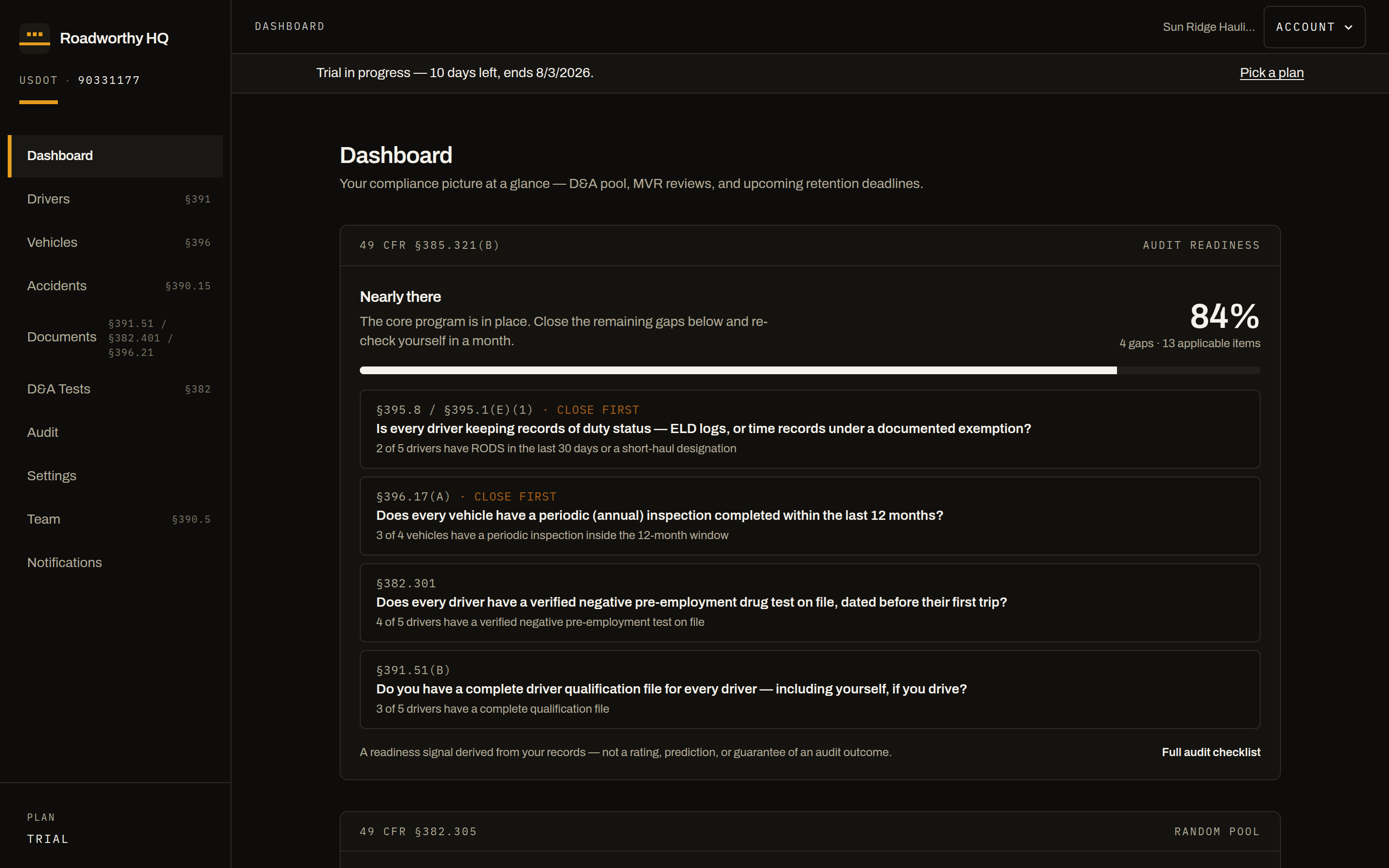
You can't control which inspector you draw, but you control the paperwork that turns a roadside stop into a clean inspection instead of a violation: current medical cards, a complete driver qualification file, a maintenance record for every truck, and honest logs. Roadworthy HQ keeps those records organized and flags what's expiring so a lapse never becomes a Driver Fitness or Vehicle Maintenance violation in the first place — which is how you stay audit-ready without a compliance department. It's a 14-day free trial, no credit card required — or look around first on the product tour, which shows the workspace on real demo-fleet data.
This article is general guidance, not legal advice. FMCSA's CSA and SMS pages are the authoritative source for the methodology.
Related violation codes
The requirements covered above are cited as these violation codes in audits and roadside inspections: