You filed for a USDOT number. Roughly 12 months later, the FMCSA — or, more often, your state's partner agency — will run a new entrant safety audit on your operation. Pass it, and the new-entrant designation lifts; fail it, and you can lose authority before your second year on the road. Which agency shows up depends on where you're domiciled: our state guides for Texas, California, Florida, Pennsylvania, Ohio, Illinois, New York, Georgia, and Michigan name the audit program in each, alongside the state-level registrations that accompany it.
This is the timeline most new carriers wish someone had given them on day one. If you want it mapped to your own dates first, the free new entrant audit timeline tool takes your USDOT activation month and shows your 12-month audit window and 18-month monitoring period on one line — no signup.
What the new entrant audit actually checks
The new entrant safety audit is governed by 49 CFR Part 385, Subpart D, and is an examination of your safety management practices and records. The auditor is not investigating whether you ran a stop sign; they're investigating whether you have the records you're required to keep, in the format you're required to keep them, for the time periods you're required to keep them.
It's worth knowing what kind of result this produces: the new entrant audit is strictly pass/fail. It does not assign a safety rating — Satisfactory, Conditional, or Unsatisfactory. That rating system belongs to a separate, more comprehensive process called a compliance review, which FMCSA can run later based on your CSA data or complaints. Don't confuse the two.
There are six core areas:
- Driver qualification (Part 391)
- Driver duty status / hours of service (Part 395)
- Vehicle maintenance and inspections (Part 396)
- Drug and alcohol testing program (Part 382)
- Operational compliance (financial responsibility, hazmat where applicable, accident register)
- Roadside inspection performance (your CSA / SMS data)
Every line below maps to one of those areas.
Month 1 — File the paperwork right the first time
The audit clock starts when your first vehicle moves in commerce, not when you got your USDOT number. So your records need to be complete from the day you start operating, not from the day the audit letter arrives.
- Confirm your USDOT registration is correct and your operation classification (interstate vs. intrastate, for-hire vs. private) matches what you actually do.
- File your MCS-150 if you haven't already and confirm the email address on file is one you actually check.
- Procure an MC number if you operate for-hire interstate.
- Buy the insurance the FMCSA requires for your authority and have your insurer file the BMC-91 (or BMC-91X when more than one insurer stacks to the limit) with FMCSA; the MCS-90 endorsement must be attached to the policy. The minimum is $750,000 for general freight under §387.9, higher for hazmat.
- Open an Unified Carrier Registration (UCR) account and pay the annual fee.
- Enroll in a drug and alcohol testing consortium (C/TPA) and pass a pre-employment drug test before the first dispatch.
Save every confirmation. Every one of these will be asked about in the audit.
Months 1–3 — Build the driver qualification file
Even if you are the only driver and you own the truck, you need a driver qualification file on yourself. The items in §391.51(b) apply to single-driver owner-operators with no exception.
The minimum DQF for a one-driver carrier:
- Driver employment application per §391.21
- Annual review of driving record per §391.25 (you review your own MVR)
- Inquiry to previous employers for the past three years per §391.23
- MVR from each licensing authority where you held any driver's license or permit in the past three years per §391.23(a)(1)
- Road test certificate or equivalent per §391.31
- Medical examiner's certificate or a legible copy (§391.51(b)(6)(i)); for CDL holders, the CDLIS motor vehicle record from the current licensing State showing medical certification status (§391.51(b)(6)(ii)). Non-CDL drivers also file the note verifying the examiner was on the National Registry (§391.51(b)(8)(i)).
- Proof of CDL, if required by your operation
Your drug & alcohol testing records are part of your compliance picture too — but they live in a separate confidential file, not the DQF. Keep them apart from day one. (See our DQF guide for the full breakdown of what goes where.)
The §391.51 retention rules are strict. The driver employment application, road test, and previous-employer inquiries are kept for the duration of employment plus three years. Annual MVRs are kept for three years. Medical certificates may be removed three years after their date (§391.51(d)(3)). Get this wrong and the auditor doesn't care about your spreadsheet.
Month 3 — Vehicle maintenance program
Two things need to be true by month 3:
- Each vehicle has had its first annual inspection per §396.17, performed by a qualified inspector, with the report retained for at least 14 months.
- You have a documented maintenance program for each vehicle — even if "the program" is "I take it to a shop." The schedule, the work performed, the dates, and the receipts are all part of the maintenance file.
Driver vehicle inspection reports (DVIRs) under §396.11 must be in place from day one of operation. If a defect is reported, the repair has to be documented. If no defect is found, no driver has to prepare a report for that day (§396.11(a)(2)(i)) — and a carrier operating only one commercial motor vehicle is exempt from the written DVIR requirement entirely under §396.11(a)(5), though the pre-trip duty in §392.7 and the maintenance file in §396.3 still apply.
Month 6 — Mid-cycle paperwork audit on yourself
Six months in, do a full self-audit. The most common reasons new entrants fail their audit are not running a drug & alcohol program, not having an annual inspection on file, and not being able to produce HOS records on demand. Self-check:
- Random testing pool: are you enrolled in a consortium and is the C/TPA running selections at the 2026 rates (50% drugs, 10% alcohol)?
- HOS supporting documents: are you keeping six months of supporting documents per §395.11 — fuel receipts, toll records, dispatch records, payroll?
- Roadside inspections: have you had any? If yes, are the inspection reports filed and any out-of-service violations resolved with evidence of repair?
- Accident register: do you have an accident register per §390.15(b), even if it's empty?
Fix what's missing now. Six months of corrective effort beats six days of panic. If you want this self-audit scored, the free audit readiness check walks the same audit areas in 13 questions and hands you a gap report with the CFR citation for each miss.
Month 9 — Pre-audit binder
Most new-entrant audits happen between months 9 and 12. Build the binder now so when the letter arrives you're not retrieving records under stress:
- Carrier identification and operating authority documents
- Insurance filings and certificates
- Driver qualification files (one folder per driver)
- Drug & alcohol program documents (consortium agreement, policy, test records, supervisor training certificates) — kept in their own confidential file, separate from the DQFs
- Vehicle maintenance and inspection records (one folder per vehicle)
- HOS records and supporting documents (six rolling months)
- Accident register (and accident files for any DOT-recordable accidents)
- Roadside inspection reports
- MCS-150 confirmation, UCR confirmation, IFTA / IRP filings if applicable
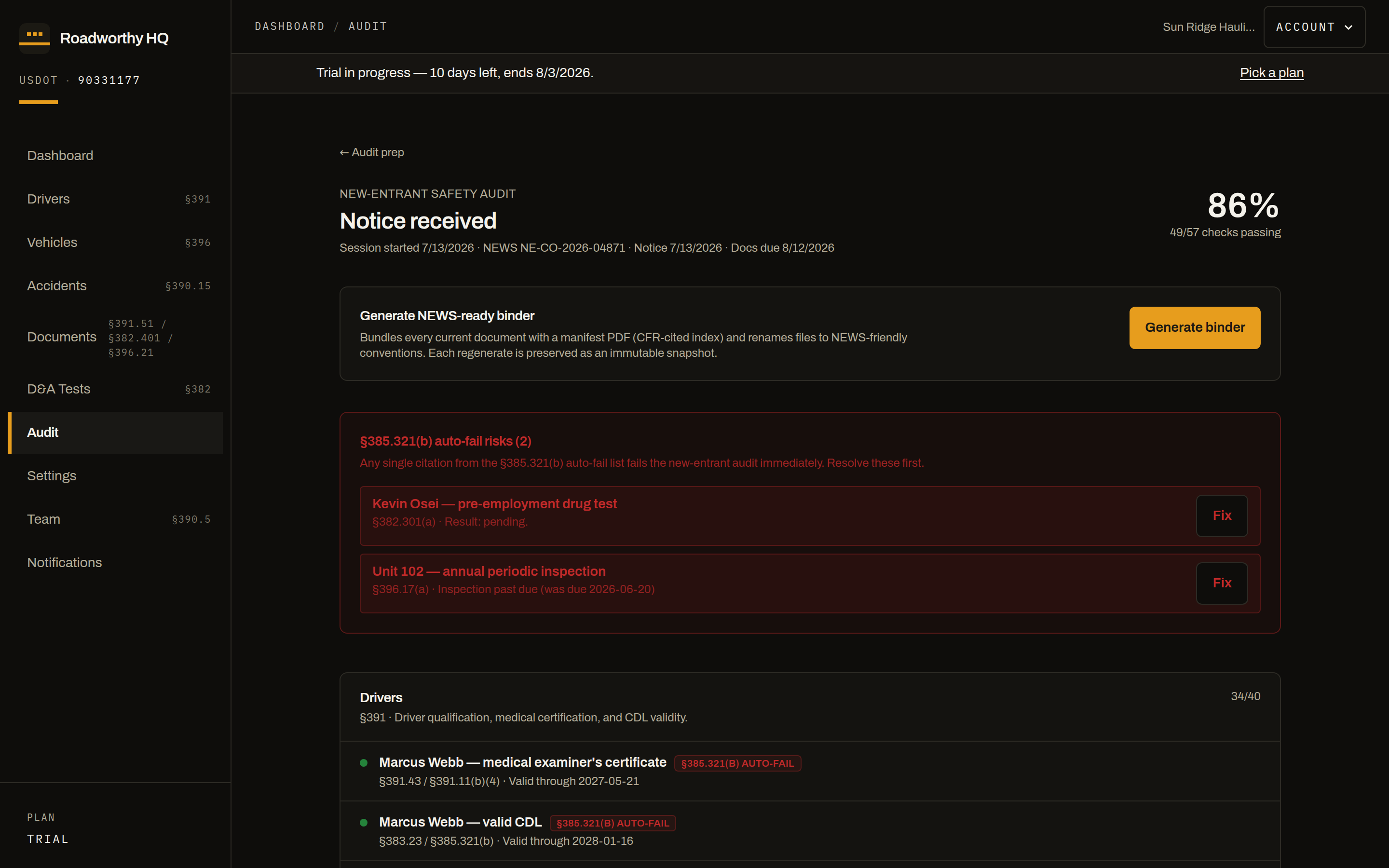
Roadworthy HQ's audit binder builds most of this automatically from what you upload: driver files, drug & alcohol documents, vehicle inspection reports, accident files, and carrier filings such as the insurance certificate and MCS-150 confirmation. It does not hold HOS records, roadside inspection reports, or UCR / IFTA / IRP filings, so those folders stay yours to assemble. If you're doing it all manually, the file structure above is the one auditors recognize.
Month 12 — The audit itself
The auditor will email or mail a letter scheduling the audit. Most are now conducted off-site: you upload requested documents to a portal, then have a phone or video interview. Some are still conducted on-site. We cover the letter itself — what the notice says, the document request list, and how the upload process works — in what to expect when the audit letter arrives.
What to do when the letter arrives:
- Read the letter carefully and note the document request list and the deadline.
- Confirm scheduling. Don't ask for an extension unless you actually need one — auditors note the request.
- Upload exactly what was requested, in the format requested, with each file clearly named.
- Review the records yourself before you send them. Catch your own mistakes.
- On the call, answer questions plainly. "I don't know, but I can confirm and send it" is a fine answer. Speculation is not.
After the audit, you'll receive a determination. If you pass, the new-entrant designation lifts after the 18-month monitoring period from the date of registration (assuming a safety audit was performed and you're not under an out-of-service order). If you don't pass, you'll receive a corrective action plan with a deadline — the full sequence, deadlines included, is in what happens if you fail the new entrant audit. Most CAPs are cured; ignored ones lead to revocation.
A note on outcomes
This article is general guidance, not legal advice. No software — and no compliance vendor — can guarantee an audit outcome. What software can do is keep your records complete, current, and in the format an auditor expects. That removes the most common reasons carriers fail. The rest is operating safely.
If you want the recordkeeping handled, Roadworthy HQ was built for exactly this carrier — the new-entrant owner-operator with one truck and a deadline.
Related violation codes
The requirements covered above are cited as these violation codes in audits and roadside inspections:
- §391.51 — Driver qualification file incomplete
- §391.21 — No or incomplete application for employment
- §391.23 — Previous-employer investigation not made
- §391.25 — Annual driving record inquiry and review
- §391.31 — Road test required
- §391.41(a) — Driver lacking valid medical certificate
- §395.11 — HOS supporting documents missing
- §396.11 — Driver vehicle inspection report violations
- §396.17 — Periodic (annual) inspection violations
- §390.15(b) — Accident register missing or incomplete