If the driver qualification file is the most common reason small carriers fail a new-entrant audit, the vehicle maintenance file is a close second — and it fails for a more frustrating reason. Most carriers actually do the maintenance. They just can't prove it. Part 396 is a recordkeeping rule wearing a maintenance rule's clothes, and the records have three different retention clocks running at once.
This guide covers every record 49 CFR Part 396 expects per vehicle, what each is for, and how long it lives.
Three record types, three clocks
The Part 396 paper trail breaks into three distinct things that carriers constantly blur together:
- The maintenance file (§396.3) — the ongoing record of inspection, repair, and maintenance per vehicle. Kept for 1 year while you control the vehicle, plus 6 months after it leaves.
- Driver vehicle inspection reports (§396.11) — defect reports at the end of each day's work. Kept 3 months.
- The annual periodic inspection (§396.17–.23) — the once-every-12-months inspection by a qualified inspector. Report kept 14 months.
An auditor will ask about all three, separately. Doing the annual inspection doesn't satisfy the maintenance file. Keeping repair receipts doesn't satisfy the annual inspection. Each clock runs independently.
The maintenance file: §396.3
The general duty in §396.3(a) is broad — every carrier must systematically inspect, repair, and maintain every vehicle under its control, and keep parts and accessories in safe operating condition at all times. "Systematically" is the operative word. An auditor reads it as: you have a schedule, and you can show it.
For every vehicle you control for 30 consecutive days or more, §396.3(b) requires a file containing:
- Identifying information: company unit number (if you assign them), make, serial number/VIN, and year. If you don't own the vehicle, the name of whoever furnishes it (your leasing company, for instance). Tire size used to be on this list — FMCSA removed it effective July 21, 2026 (91 FR 45653) as obsolete. If your existing files have it, leave it; you just don't have to capture it going forward.
- A means to indicate the nature and due date of inspection and maintenance operations. This is your preventive maintenance schedule — oil at X miles, brake check at Y, annual inspection due in month Z. The regulation doesn't dictate a format; it dictates that the plan exists in writing.
- A record of inspection, repairs, and maintenance showing the date and what was done. Shop invoices, work orders, and receipts all count — if they identify the vehicle and the work.
Retention: 1 year where the vehicle is housed or maintained, and 6 months after the vehicle leaves your control (§396.3(c)). That trailing 6 months catches people: sell the truck, and its file still has half a year to live.
The PM schedule is the most-missed item of the three. Carriers who fix everything promptly still get cited because nothing in the file indicates the nature and due date of upcoming maintenance. The work happened; the system that §396.3 actually requires was never written down.
DVIRs: §396.11
The driver vehicle inspection report is the end-of-day defect report. Since the FMCSA's 2014 rule change, property-carrying drivers only file a DVIR when there's a defect to report — the daily no-defect DVIR is gone for property carriers. (FMCSA scoped the 2014 relief to property-carrying vehicles and its DVIR guidance still has passenger carriers filing daily; that split lives in the rulemaking and guidance rather than in the text of §396.11 itself.)
When a defect affecting safe operation is found or reported, the sequence matters:
- Driver reports the defect on the DVIR at the completion of the day's work.
- The carrier repairs the defect — or determines repair is unnecessary — before the vehicle is dispatched again, and certifies that on the report.
- The next driver reviews the previous DVIR before driving and signs to acknowledge the review if defects were noted (§396.13).
Retention: 3 months from the date the report was prepared, including the repair certification.
The single-truck exception, stated precisely: §396.11(a)(5) says the DVIR rules don't apply to a motor carrier operating only one commercial motor vehicle. If that's you, you're technically exempt from the written report. You are not exempt from the pre-trip satisfaction requirement (§396.13 and §392.7) or from the §396.3 maintenance file. Many one-truck operators keep DVIRs anyway — they're cheap to produce, and a stack of clean inspection reports is useful evidence if you're ever in a crash lawsuit. But know the difference between "required" and "smart": an auditor can't cite a solo operator for missing DVIRs, and you shouldn't let anyone tell you otherwise.
The annual inspection: §396.17 through §396.23
Every CMV must pass a periodic inspection at least once every 12 months (§396.17). Three details that trip up small carriers:
Every unit counts separately. In a tractor-trailer combination, the tractor needs its own annual inspection and the trailer needs its own. A converter dolly is its own unit too. "The truck passed" doesn't cover the trailer it pulls.
The inspector must be qualified (§396.19): trained through a state or federal program or certified, or with at least a year of relevant training and experience, and equipped to inspect against the standards in Appendix A to Part 396. A reputable commercial shop will meet this and say so on the report. If you're qualified, you can self-inspect — but your qualification evidence becomes a record too, retained for as long as you perform inspections plus one year.
A roadside inspection doesn't count. A clean CVSA Level I at a scale house feels like an annual inspection, but per FMCSA guidance it does not satisfy §396.17. A state periodic inspection program that meets the Appendix A minimums can (§396.23) — and §396.17(c) measures the clock the same way for any inspection: each component must have passed within the preceding 12 months.
The proof requirement is two-part. The vehicle itself must carry evidence — the inspection report or a sticker/decal showing the inspection date, who holds the report, and vehicle identification. And the carrier must retain the original or a copy of the inspection report for 14 months (§396.21(b)), producible on demand. If a shop did the inspection, getting a copy of the report is on you. The sticker on the door post is not your file copy.
The report itself must identify the inspector, the carrier, the date, the vehicle, and the components inspected with results (§396.21(a)). If the shop's paperwork doesn't name the components against the Appendix A standards, push back and get the full report.
Roadside inspections feed the same folder
When you're inspected roadside, the report doesn't vanish into the CVSA ether — §396.9 puts it in your lap. The driver delivers the report to the carrier, and the carrier corrects any violations noted — an out-of-service defect keeps the vehicle parked until it's fixed (§396.11(a)(3)).
What happens to the paperwork changed on July 22, 2026. Under the revised §396.9(d)(3)(ii) (91 FR 37053), you return the completed form to the issuing State agency only if that State requests it — before this rule, the return applied after every inspection, every State. You still certify the corrections after any inspection with violations, by signing the form within 15 days (§396.9(d)(3)(i) is unchanged); only the trip back in the mail became conditional. FMCSA has said it will not publish a list of which States request returns, so check the address block on the form and the practice of the States you run in; when in doubt, returning anyway costs you a stamp. Either way, in all cases, you retain a copy of the report — with your correction certification — for 12 months from the inspection date. (Yes, a fourth clock. Nobody said this part was elegant.)
Those results also feed your CSA Vehicle Maintenance score, and the national pattern tells you where to focus: in CVSA's 2025 International Roadcheck, brake-related violations were the leading vehicle out-of-service category at roughly 41% of vehicle OOS, with tires next at around 21%. Brakes and tires. If your PM schedule is thin anywhere, it shouldn't be thin there.
What the per-vehicle file looks like
One file per vehicle, and this is the structure an auditor can scan in two minutes:
- Identification sheet — unit number, make, VIN, year, owner if leased
- The PM schedule — nature and due date of each maintenance operation
- Service and repair history — dated records of work performed
- Most recent annual inspection report (14-month clock)
- DVIRs with defects and repair certifications, if you're required to keep them or choose to (3-month clock)
- Roadside inspection reports with correction certifications (12-month clock)
It's the same discipline as the driver qualification file — a defined list, a defined order, and a retention clock per item — applied to the truck instead of the driver.
Common Part 396 audit findings
- No annual inspection on file. The big one — §396.17(a) is a critical violation in Appendix B to Part 385, which feeds the safety-rating calculation. Usually it's not that the inspection never happened; it's that nobody kept the report.
- No PM schedule. Receipts prove repairs happened; they don't prove a system. The "means to indicate nature and due date" is its own requirement.
- Missing identifying data. Auditors write carriers up for identification sheets missing a field — make, VIN, year, or the furnisher's name on a leased unit. It reads as petty until you remember §396.3(b)(1) lists each one by name.
- Trailer never inspected. The tractor's annual is current; the trailer's never had one. Every unit, separately.
- Defect DVIRs without repair certification. The driver reported it; no one documented the fix before the next dispatch.
- Expired clock on a sold vehicle. The file goes in the shredder the day the truck sells — six months early.
Keeping the clocks straight
Four retention periods — 3 months, 12 months, 14 months, and 1 year + 6 months — across three or four record types, multiplied by every vehicle you run. On paper, that's a wall calendar problem until the day it's an audit problem.
Roadworthy HQ tracks each vehicle's maintenance file as its own record set: the PM schedule with due dates surfaced in your dashboard alerts, the annual inspection's 14-month window tracked per unit, and retention enforced by the database — documents purge automatically when the CFR retention period ends, with a 7-day grace window and legal-hold support. Like the new-entrant audit binder, the structure is built in rather than reconstructed under deadline.
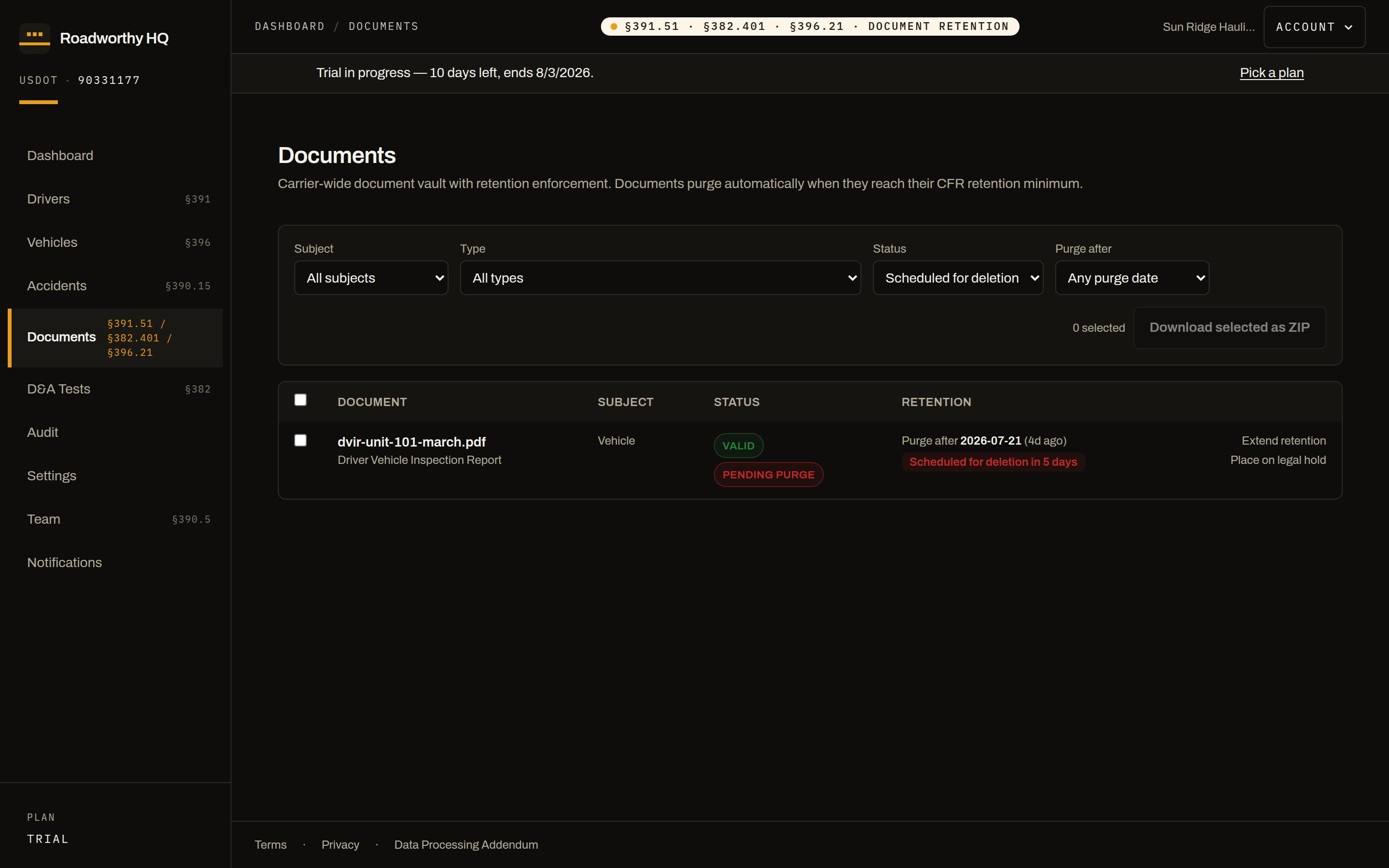
If you'd rather run it manually, the six-item file structure above and a calendar with four recurring reminders per vehicle will do the job. The regulation doesn't require software. It requires that the records exist, and that you can put your hands on them when the letter arrives.
This article is general guidance, not legal advice. 49 CFR Part 396 and the FMCSA's published guidance are the authoritative sources, and the figures here are current as of 2026.
Related violation codes
The requirements covered above are cited as these violation codes in audits and roadside inspections: