You searched for a J.J. Keller alternative, which usually means one of two things happened. Either you priced Encompass and discovered that the per-vehicle number on the website is the start of the conversation, not the end of it — or you're a one-to-ten-truck carrier who opened the product tour and realized it was built for a fleet with a safety department, and you are the safety department.
This is a comparison written by a competitor, so let's set the terms honestly up front: J.J. Keller is the most established name in DOT compliance, their products are genuinely good, and for some carriers they are the right choice. This post lays out what Encompass actually costs in 2026 (with verified figures, not rumors), what the real alternatives are — including doing it yourself for free — and how to decide based on the records you're legally required to keep, not the feature list a sales call walks you through.
What J.J. Keller actually is
J.J. Keller & Associates has been the reference vendor for transportation compliance for over 70 years. The name shows up on driver qualification file folders, training videos, and the handbooks in half the safety offices in America. Their software platform is Encompass: an ELD plus fleet-management system with compliance modules layered on — driver qualification, drug and alcohol program management, vehicle maintenance, and hours-of-service oversight.
That breadth is the point, and the pitch: one vendor for the electronic logging mandate, the compliance records, the training, and — if you want it — managed services where J.J. Keller staff run parts of your program for you.
What Encompass costs (verified July 2026):
- $25.50 per vehicle per month for the base BYOD configuration — the ELD paired with a phone or tablet you already own.
- ~$59 per vehicle per month with J.J. Keller's Compliance Tablet, which bundles a $33.50/month data plan.
- Hardware: about $199 for the ELog device, about $349 for the Compliance Tablet.
- $3.50 per month per additional driver when you manage more drivers than vehicles.
- The compliance tiers (Essential through Platinum) and add-on services — driver qualification management, drug and alcohol program administration, video — are quoted, not published. Reviewers consistently note that J.J. Keller doesn't provide pricing without customizing a quote to your organization, and multi-year contract terms are commonly reported.
None of that is a criticism by itself. Quoted pricing is how enterprise software works, because enterprise deals genuinely vary. But it means the number you can see is not the number you'll pay, and you can't know your real cost without getting on the phone.
Why small carriers go looking for an alternative
Run the math for a three-truck, three-driver operation on the visible pricing alone: three vehicles on the base BYOD plan is $76.50/month, $918/year — before hardware, before any compliance tier above the base, before the add-on modules that cover the records a new-entrant audit actually examines. Configure the tablet option and the same three trucks run about $2,124/year plus roughly $1,047 in hardware. Whatever the quoted compliance modules add, you'll learn on the call.
The recurring themes among small carriers who switch away — or never sign — are:
- Per-unit pricing scales the wrong way for you. Per-vehicle, per-driver pricing is fair for a 50-truck fleet and expensive per-truck for a 3-truck one, because the compliance work doesn't scale with vehicles. A driver qualification file per 49 CFR §391.51 has the same eight items in it whether you employ one driver or forty.
- The must-have and the nice-to-have arrive welded together. Encompass is an ELD platform first; the compliance modules ride on it. If you already have an ELD you're happy with — or you run vehicles under 10,001 lbs that don't require one — you're buying a logging platform to get a records system.
- You still have to understand the regulation. Software that stores your documents doesn't tell you whether the file is complete, what the retention clock on each record is, or which gaps are the ones that fail an audit outright. That knowledge lives in white papers and advisor add-ons, at additional cost.
First, decide what you're actually hiring
"DOT compliance" gets sold three fundamentally different ways, and most bad purchases come from buying the wrong shape, not the wrong brand:
- Software you operate. A workspace that holds your driver files, drug and alcohol program records, and maintenance documents, tracks the deadlines, and tells you what's missing. You do the work; the system makes the work legible. Encompass (self-managed) and Roadworthy HQ are this shape.
- Services you outsource to. A company whose staff run parts of the program for you — screening, file building, program administration. Foley is the clearest example: their Dash platform comes wrapped in U.S.-based compliance support, and the pitch is that their specialists handle it while you read results. Foley publishes three tier names (Essential, Professional, Power) and no prices — every path on their pricing page ends at a demo form (verified July 2026). J.J. Keller's managed services compete here too.
- Doing it yourself. Genuinely viable, and free. More on that below, because any vendor who pretends otherwise is selling you fear.
What you're hiring for is the same list regardless — the records a 1–10-truck carrier is required to keep, which is also precisely the list a new-entrant safety audit samples:
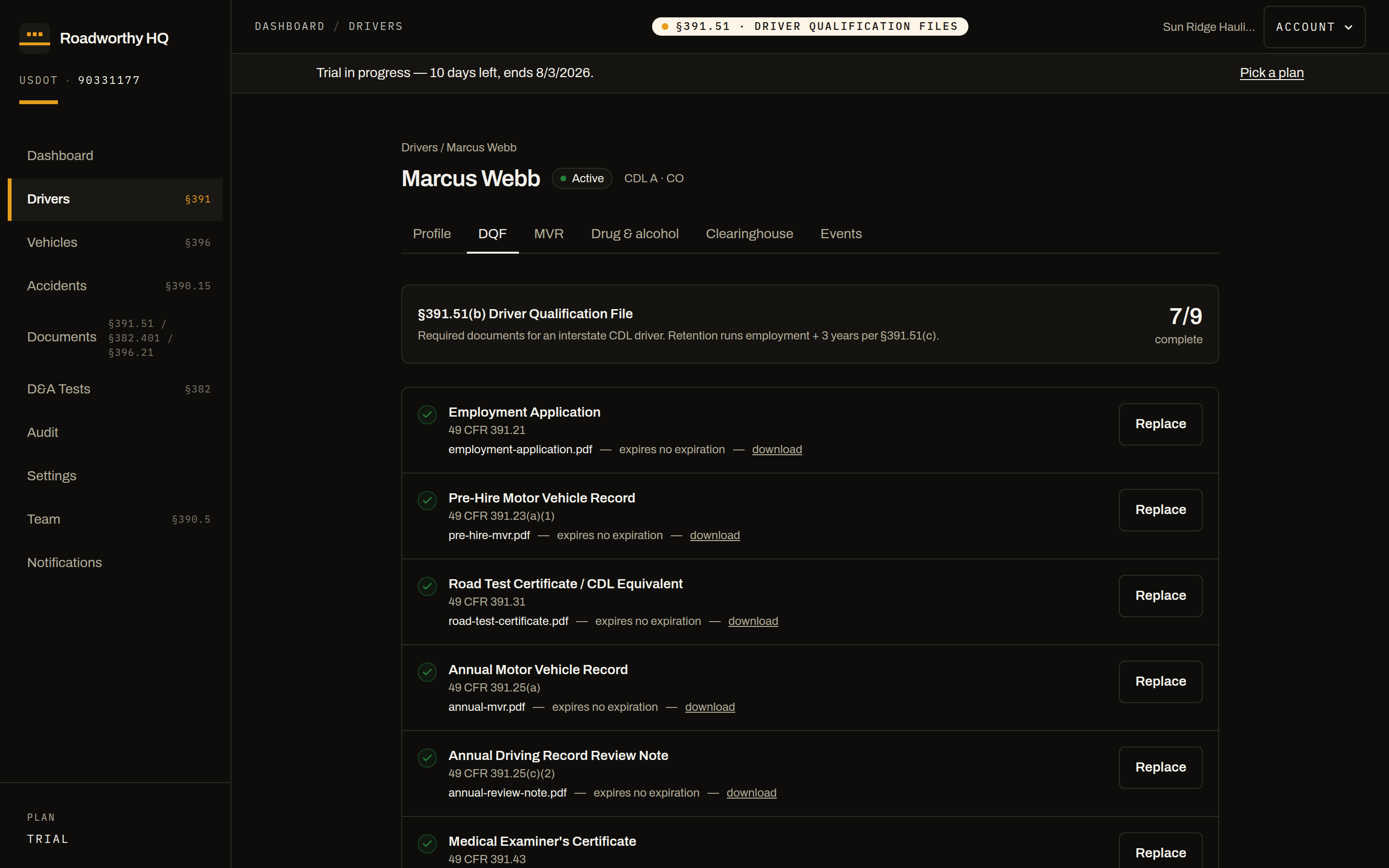
- A complete driver qualification file per §391.51 for every driver, including yourself (the item-by-item build guide).
- A drug and alcohol program per Part 382 — a written policy, pre-employment tests, Clearinghouse queries, and enrollment in a random testing pool per §382.305. If you're an owner-operator, that means a consortium membership, which no software subscription replaces.
- Vehicle files per Part 396 — systematic inspection, repair, and maintenance records per §396.3, DVIRs where required, and the periodic (annual) inspection.
- Hours-of-service records and supporting documents, from your ELD or time records.
- An accident register per §390.15.
That first item is what "compliance software" should make visible. This is what it looks like as a tracked checklist rather than a folder:
The honest comparison
| J.J. Keller Encompass | Foley | Do it yourself | Roadworthy HQ | |
|---|---|---|---|---|
| Shape | ELD + fleet platform with compliance modules | Service-led: specialists + Dash software | You + a filing system | Compliance records workspace |
| Published price | $25.50–$59/vehicle/mo + $3.50/driver/mo; modules quoted | None — three tiers, quote only | $0 | $39 / $89 / $149 flat per month |
| Pricing scales by | Vehicles + drivers + modules | Quote | Your time | Fleet size band, flat |
| ELD included | Yes — it's the core | No (compliance focus) | Your existing ELD | No — bring your own |
| Who does the work | You (or paid managed services) | Mostly them | You | You |
| Contract | Multi-year terms commonly reported | Quote-dependent | None | Month-to-month, cancel anytime |
| Best fit | 10+ trucks wanting one vendor for ELD + compliance | Carriers who want screening/onboarding run for them | Disciplined solo operators with more time than budget | 1–10 trucks, self-serve, flat cost |
(Competitor figures verified July 2026 from published pricing and current third-party reviews; quoted-only items are marked as such. Prices change — check the vendor's page before deciding. For the wider field of small-fleet records tools — FileFlo, TruckDocsAI, FleetCollect, Dotra — see the 2026 new-entrant audit software comparison.)
When J.J. Keller is the right answer: you're at or past ten trucks, you want the ELD and compliance stack from one vendor, you have — or are hiring — someone whose job is safety, and predictable per-unit pricing at your scale beats flat pricing. Their content and training libraries are real assets. Nothing on this page argues a 30-truck fleet out of Encompass.
When Foley is the right answer: your bottleneck is hiring and screening volume, and you want humans processing MVRs, PSP reports, and files rather than software prompting you to. You're buying labor, and labor is worth paying for — just get the quote in writing and compare it against the cost of doing the same work in-house.
When DIY is the right answer: you're a solo owner-operator, money is tighter than time, and you'll actually maintain the discipline. FMCSA publishes its Safety Audit Resource Guide and the entire CFR is free to read. A folder structure, a consortium membership, and a calendar you trust can pass an audit. The honest risks are silent ones: a medical certificate that expires unnoticed, an annual MVR review that never happens, a DVIR retention clock nobody tracks. Audits sample records; the gap you don't know about is the finding.
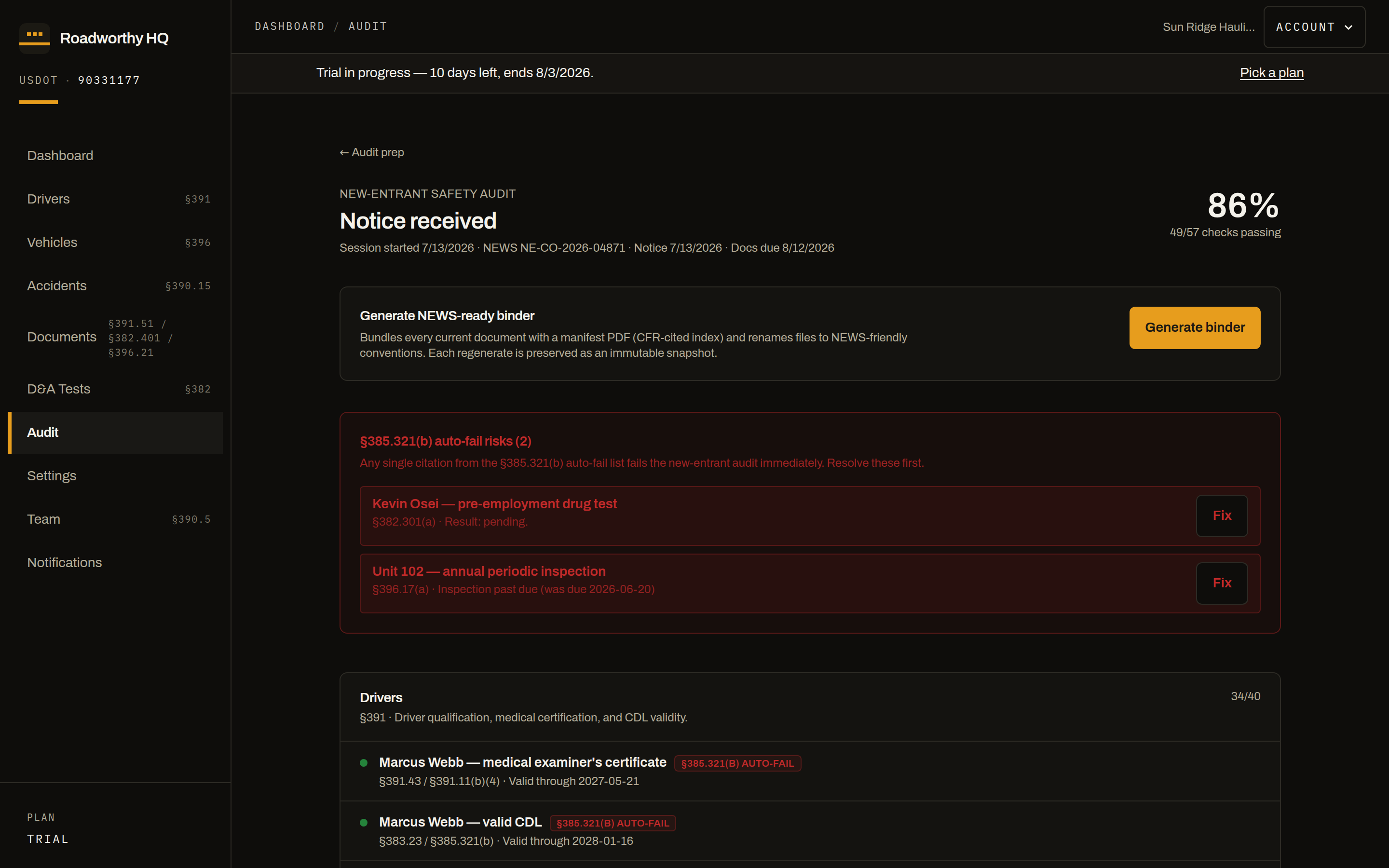
When Roadworthy HQ is the right answer: you run one to ten trucks and want the records workspace without the platform. Driver qualification files with every §391.51(b) item as a tracked checklist, the drug and alcohol program with random-pool math and a Clearinghouse query tracker, vehicle and maintenance files with retention enforced by the database rather than by memory, and a one-click audit binder export when the letter comes. Pricing is flat and public — $39, $89, or $149 a month by fleet size, no per-driver fees, no contract, and no sales call, because the entire product is on the tour page and the demo is one click. To be equally clear about what it is not: Roadworthy HQ is not an ELD — you keep whichever ELD you run today — and it is a records workspace, not a managed service or a testing provider.
Questions that cut through any sales call
Whoever you evaluate — including us — these six questions separate a compliance system from a document bucket:
- Does it know the retention window of each record, and enforce it? A DVIR is kept three months; an annual MVR, three years; a positive test result, five. If the system can't tell you when a record's clock expires, you're still the retention system.
- Does it show the regulation next to the requirement? When an alert fires, does it cite the section so you can read why — or do you need a separate advisory subscription for that?
- What exactly is quoted vs. published? Get the all-in annual number for your actual fleet size, in writing, including every module you need for an audit.
- What's the contract term, and what does leaving look like? Can you export every record you stored, in a format an auditor accepts, after you cancel?
- What happens when the audit letter arrives? Ask to see the export. If assembling your records for FMCSA is a services engagement, that's a real cost too.
- Which parts of compliance does it not cover? Every product has an honest answer. A vendor without one is the red flag.
Question 5 applies to us too, so here is our answer — the audit-prep workspace with the export in view:
If you want to see how your current records stand before talking to anyone, the free audit readiness check scores the same areas an auditor samples, in about five minutes, no account required. And if you land on Roadworthy HQ, the 14-day trial is free, self-serve, and doesn't ask for a card — audit-ready is the goal, and you can judge in a week whether the workspace gets you there faster than the binder.
Related violation codes
The requirements covered above are cited as these violation codes in audits and roadside inspections: